TorqBolt offers two different Zeron 100
round bar products to service the fastener industry with high strength, highly
corrosion resistant products.
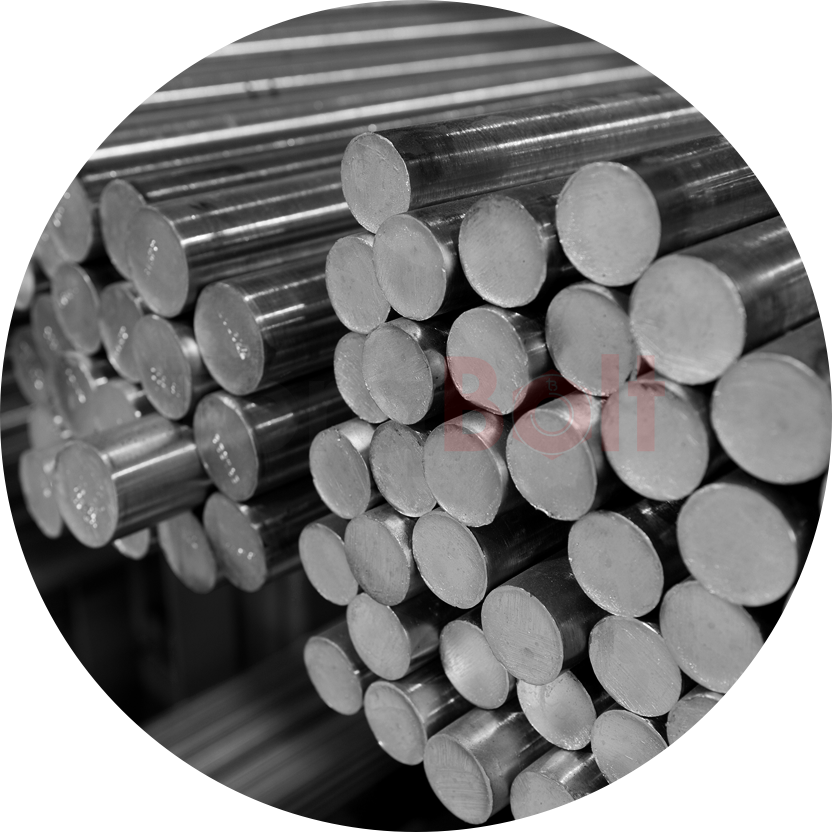
- Zeron 100 SA (Solution Annealed) – Standard Product
- Zeron 100 FG (Fastener Grade)
To provide a Zeron 100 bar products with increased tensile
properties the Zeron 100 FG variety was created. Lightly cold
working the bar to its final size provides higher strength. Zeron 100 FG meets
the requirements of ASTM A276 for UNS S32760 Condition S. “S” indicates the
strain hardened condition. For faster design purposes, Zeron 100 FG
meets the mechanical requirements of ASTM A193, Grade B7 material. ASTM A193 is a
specification covering alloy and stainless steel bolting for high temperature or
high pressure service. Zeron 100 is not specifically addressed in the
specification, so the B7 grade is referenced for mechanical property
information.
Pipework systems handling corrosive fluids frequently call for Zeron 100. Although many pipes and fittings are joined by welding, in some
places it is necessary to use flange connections. Where corrosion of the flange
bolts may occur it is desirable to use corrosion resistant fasteners. The alloy
is available as a fastener in two different grades. FG grade meets the tensile
properties of ASTM A193 grade B7. The solution-annealed condition is also offered as fasteners
in the solution annealed form. This has a lower yield and tensile strength
compared with FG, but headed fasteners can be manufactured more cheaply in the
solution annealed condition. This is because solution annealed bolts can be
headed by forging followed by solution annealing, while FG, whose properties are
produced by controlled strain hardening, must be machined from bar.
Galling
is often assumed to be a problem with stainless steels. The problem is
traditionally associated with 300 series austenitic alloys. Galling is less of a
problem with more highly alloyed austenitic and duplex alloys. Bar in Zeron 100 SA for nuts, is supplied in the solution
annealed condition. This typically has a hardness of 50HV less than that of cold
worked FG material. This will minimize the risk of galling. Zeron
100 bolts have been used for many years in submersible marine pumps and it
is common practice to coat fasteners with ~6μm of copper. This is produced by
electroplating and is usually applied to the male stud. This is to ensure ease in
dismantling for servicing of the pumps. In critical applications, where very high
torques are required, successful use has been reported of conventional
anti-galling sprays (e.g. Rocol), copper-loaded greases, and PTFE coatings. The
use of molybdenum disulphide lubricant should be avoided for elevated temperature
service, because of the risk of decomposition of the lubricant leading to
sulphide attack.
The Zeron 100 FG also meets the minimum Charpy impact
toughness values of 40 joules (29.5 ft-lbf) at -50°C (-58°F).
Solution-annealed Zeron 100 (SA) hits ASTM A479 minimums, 550 MPa yield, 750 MPa UTS, which is plenty for most super-duplex stud bolting. But several buyer specs reference ASTM A193 B7 mechanical envelope (yield 720 MPa, UTS 860 MPa) as the benchmark for high-strength flange bolting. SA Zeron 100 falls 30% short on yield. The fix isn't a different alloy, it's a different supply state. Zeron 100 FG takes the same SA bar and lightly cold-draws it to its final size; the strain-induced dislocation density lifts yield to 700-800 MPa and UTS to 870-940 MPa, putting Zeron 100 squarely in A193 B7 territory while keeping the super duplex corrosion envelope intact.
FG sits in ASTM A276 / A479 Condition S, the strain-hardened condition. Hardness stays under the 28 HRC NACE MR0175 ceiling for sour service (typically 24-28 HRC). The cold work also raises Charpy V-notch ductile-to-brittle transition slightly, FG meets ≥ 40 J at -50°C (typically 50-90 J range), which is acceptable for North Sea topside service but not deepwater Arctic; for the latter, the FLT supply state holds the higher Charpy reserve.
Standards FG Complies With
FG owes its strength to controlled cold-work in the bar, the dislocation density built up during the final cold-draw is what raises yield from SA's 550 MPa to FG's 700+ MPa. Hot-forging a bolt head from FG bar would re-heat the metal above the recovery temperature and undo that cold work, dropping the bolt back to SA properties. The mechanically valid manufacturing path is therefore machine-from-bar: FG bar is turned and threaded, never hot-headed. This is why Zeron 100 hex bolts in FG are CNC-turned from hex bar, not impact-headed from coil. Heavy hex nuts cannot be made in FG at all, they're hot-forged then SA, sitting in the SA supply state by necessity. When a bill of material calls for FG studs and matching nuts, the nuts ship in SA condition; the joint is engineered around that mismatch (the heavy nut pattern carries the mismatch, see ASME B18.2.4.6M proof-load tables).
- Heat number traceability, mill heat → bar receipt → cold-draw lot → finished fastener serial
- Chemistry, full elemental vs ASTM A479 / EN 10088-3 ranges (Cr, Ni, Mo, N, Cu, W, Mn, Si, P, S, C)
- Mechanical, yield, tensile, elongation, RA per ASTM A370 (witness coupon from same heat + same cold-work lot)
- Hardness, body (Rockwell C) + rolled-thread root (Vickers HV converted to HRC); both reported, NACE-judged on the higher
- Charpy V-notch, at -50°C, 3 specimens, average ≥ 40 J
- Ferrite content, ASTM E562 metallographic count or EN ISO 8249 magnetic, target 40-52%
- CPT, ASTM G48 Method E, 24 hr at 50°C in 6% FeCl3; pass = no pitting
- Sigma-phase test, ASTM A923 Method C, Charpy at room temperature ≥ 60 J
- NDT, visual + dimensional 100%; MPI on rolled threads per ASME B1.13M
- PMI, 100% with calibrated XRF against S32760 master
- EN 10204 type, 3.1 (in-house QC) or 3.2 (witnessed by TUV / BV / DNV / Lloyd's / ABS) per buyer spec
- NORSOK M-650 QTR reference, included on cert when buyer spec requires
Mechanically yes, metallurgically no. FG matches A193 B7 yield (~720 MPa) and tensile (~860 MPa) so it can substitute B7 in load-path-equivalent service. But B7 is AISI 4140 alloy steel (carbon steel + Cr-Mo), no corrosion resistance to chlorides or sour fluids. Zeron 100 FG is super duplex stainless steel (25Cr-7Ni-3.5Mo-Cu-W-N), PREN ≥ 40, CPT ≥ 50°C, NACE MR0175-controlled. Use FG when you need B7-class strength AND corrosion resistance; use B7 when corrosion is not in scope.
FG strength comes from cold-work in the bar. Hot-heading re-heats the upset region above the recovery temperature (above ~600°C the dislocation tangle anneals out), which restores SA properties at the head. The bolt would then have a strong shaft and a weak head, unacceptable. FG bolts must be machined from bar (CNC-turned and roll-threaded) so the cold-work envelope is preserved end-to-end. Heavy hex nuts cannot be made in FG at all because nuts are hot-forged then solution-annealed; nuts always ship SA.
Roughly 25-40% depending on size and lot. The premium comes from (a) the additional cold-draw mill operation, (b) the requirement to machine from bar rather than hot-head, (c) closer NACE-controlled hardness band, and (d) more witnessed mechanical testing on the cert. The premium is justified for sour-service, NORSOK, or A193 B7-substitution applications; for non-load-critical fasteners SA is the right call.
Yes, MDS 055 is written around the cold-worked condition for stud bolts and other fasteners. Acceptance criteria: chemistry per Type 25Cr (S32760), ferrite 35-55%, hardness ≤ 28 HRC, Charpy ≥ 45 J at -46°C average + 35 J minimum. Our FG production is qualified to MDS 055 and the QTR record is referenced on every NORSOK-spec cert.
Up to ~250°C continuous operation is fine, FG retains most of its cold-work strength to that temperature. Above 300°C super duplex starts to lose toughness due to 475°C embrittlement onset (Cr-rich α' precipitation in the ferrite phase), not a strength problem but a Charpy reduction. For continuous service above 300°C consider Inconel 625 or Inconel 718 instead; super duplex (any supply state) is not the right alloy at that envelope.
Send the spec (form, bar / bolt / stud / nut, size, length, standards / MDS to comply with, quantity, destination port) to info@torqbolt.com or +91-22-66157017 / WhatsApp. We reply with stock availability, mill route, lead time, MTC tier, and price within one business day (Mumbai IST).
Certifications
- ISO 9001 - 2015 Certified
- PED 2014/68/EC
- NACE MR0175/ISO 15156-2
- NORSOK M-650 MDS 055
- DFAR
- MERKBLATT AD 2000 W2/W7/W10